


 Posts
Posts


Showing posts with label character. Show all posts
Showing posts with label character. Show all posts
1/24/2010
Compassion in action
My friend Lori Ann Bloomfield, over on her blog First Line, has posted an excellent comment on how writers can help not only Haitians but all human beings, simply through the act of writing. By writing more human characters, she says, we come to understand our fellow human beings better, and it's a very small step from there to full compassion for all humanity. Better still, when we compassionately write fully realized, human characters, we invite our readers to a broader, more compassionate view of the world. It's a beautiful post, and I encourage everyone to check it out.


1/20/2010
Research tip #6: Marbling
So now you have all your research done and you’re ready to get back to the writing. But you’re writing fiction here, not a research paper—so how do you use this research you’ve done? Sometimes the answer is easy: You were looking for a particular detail, and you found it, and you just plug it in and keep on working. But other times your research will be background—you’d written a quick rough draft but needed to learn a lot more about the time period, or the industry, or the culture, or whatever it is you’re writing about, so you’ve spent days or weeks or even months plowing through piles of research, and now you need to return to that draft of yours and work in what you learned. And this is where things get tricky.
The simple answer is to always focus on the writing. If you learned what you studied, if you absorbed all that research you did, then you should be able to just start revising the text and the details will fall in on their own. But let’s be honest, writing is almost never as easy as shaking our heads and letting the genius sift down. You’re going to have to work at this, and it’s going to have to be precise and intentional.

So let’s set aside the writing for a minute and go bake a cake.
In his screenwriting book, Story Sense, Paul Lucey discusses working research into a story:
Because we’re writers and therefore probably also book nerds, we might be tempted to think of marbling in terms of paper-dying, the art form in which you swirl inks and dyes on paper to produce wild, psychedelic patterns. But I think this is a poor metaphor, because the result is a disorienting churn of color that does not help anyone perceive either the larger picture or the individual hues. Instead, I think the term “marbling” as used for fiction is best related to marbling in baking. For those of you who’ve never been up to your elbows in flour, marbling in baking refers to swirling two contrasting batters—one light, one dark, usually vanilla and chocolate—into a single cake, so the baked cake comes out looking like marble (or like marbled paper). But bakers know that the secret to a good marbled cake is neither the separation of the flavors nor the blend of flavors, but the complement of flavors: we don’t want to taste chocolate and then vanilla, and we don’t want to taste chocolate-vanilla; we want to taste how chocolate and vanilla play off each other in a single bite.
In fiction, we “marble” our details in such a way that they neither stand out as a distinct list of details (“Look what I learned!”) nor blend in as indistinct jumbles of words. Instead, marbled details should work their way into a story so they complement the story—they show us details not to inform the reader but to inform the story, to provide depth to character, to drive the plot, to set the mood.
And we should never forget that this is the function of our research—to serve as details in a story. This can feel frustrating sometimes in the same way that cooking frustrates some people. You spend hours and hours in the kitchen, tossing up a huge mess and stacking dirty dishes you’ll just have to spend hours cleaning later, but the final result is a single plate of food that someone wolfs down in maybe 20 minutes, and then it’s over. Similarly, when you spend hours or days rubbing your weary eyeballs and your hands have gone dry from flipping pages and you’ve learned an entire history inside and out, it can be terribly frustrating to find that all that work boils down to a single detail, a phrase in a sentence. You are tempted, I bet, to pour on the details, to load in everything you learned just to prove that you did the work. But this is not why we did the research; we’re not out to prove anything, we’re out to tell a story.
Francine Prose, in Reading Like a Writer, puts it this way:
Yes, your research lends your fiction a certain authority, a sense that you know what you’re talking about, or at least your narrator does. A lot of great authors made sure they did know what they were talking about—when you read Hemingway’s vivid descriptions of lion-hunting in Africa, you know that old Papa Hemingway actually hefted a rifle and trekked out on safari, actually shot at the king of cats himself. But in Bird by Bird, Anne Lamott tells of writing a story about gardening based solely on research and on going to the source (in this case, a horticulturalist as well as dozens of happy home gardeners) and then catching people off guard when they assumed she herself was a gardener. “I’d let them know that I had only been winging it, with a lot of help from people around me. [. . .] ‘You don’t love to garden?’ they’d ask me incredulously, and I’d shake my head and not mention that what I love are cut flowers, because this sounds so violent and decadent [. . .].”
So you find only those details that are necessary, only the research that serves the story, and then you work it in where it’s necessary and only there. In her book Building Fiction, Jesse Lee Kercheval explains how Tim O’Brien (who, to be fair, was indeed a Vietnam veteran, so his details came first-hand) worked in whole lists of specific facts to lend realism to his short story “The Things They Carried.”
The information here accomplishes several things at once: They give the narrator (and O’Brien himself) authority through the specificity of the details—the weight of packs, the caliber of firearm, the curious detail about the “M&Ms for especially bad wounds.” Only someone who’d been there, we would reason, could know details like that. The lists also inform us about the characters, “the cumulative impression they leave of a character’s rank and specialty,” as Kercheval puts it. (Notice that the medic carries comic books, too, which, combined with the M&M detail, tells us something about Rat Kiley the human being as well as Rat Kiley the medic.) And they move the story itself forward—the description of the platoon leader, with his weapons of war and his “responsibility for the lives of his men,” precedes the description of the medic, whose gear helps him heal the wounds of war, and this pairing creates a tension that propels the story forward.
But for the best example of how to use your research in your fiction—how to marble in the details so that they complement the story you’re telling—I will turn to the master, Cormac McCarthy, and his greatest novel so far, the brilliant historical novel Blood Meridian. (For a fascinating discussion of McCarthy’s own research and writing process, check out this rare interview, with John Jurgensen.)
In Blood Meridian, a group of men led by the violently mythic Judge Holden are running from a band of vengeful Native Americans; as one might expect in a Western, they are shooting at each other as they gallop across the West Texas desert, firing so much that the judge’s men run out of ammunition. Actually, they have plenty of bullets and plenty of empty casings and are used to recycling their rounds by recasing their own ammo, but they have run out of gunpowder. So they run to the volcanic mountains to escape, and there on the burning peaks the judge sets about making gunpowder by hand.
The process of making gunpowder involves chemically mixing potassium nitrate (saltpeter), sulfur powder, and charcoal. But these men are on the run, trapped at the top of a volcano—they’re not leisurely tinkering around with a chemistry set. McCarthy did his research, though, and he learned that human urine contains nitrogen and that saltpeter can be made from urine by mixing it with potash (wood ashes). He also must have discovered that sulfur naturally occurs in volcanic regions. And it wouldn’t be hard to come across charcoal at a volcano, either.
I did a little looking myself (okay, a very little—I just hit Wikipedia), and learned that just before the Renaissance, Europeans discovered a way to add liquid to the ingredients and create a kind of gunpowder paste, which they then dried and crushed to form gunpowder. And, according to the Wikipedia article, “gunners also found that it was more powerful and easier to load into guns.”
Perfect! But these men in Blood Meridian are on the run, in the middle of a shootout, fighting for their lives. We don’t have time to pause the action and explain all these technical, alchemical processes. We need gunpowder and we need it now! So McCarthy marbles—he keeps the action moving fiery and relentless even as he describes the powder-making process in grossly vivid detail and reveals volumes of insight into Judge Holden’s feral genius and his devlish nature:
(For any chemistry nerds reading, I should point out that most information online explains that making gunpowder takes an incredibly long time, upwards of two days or more, so I know there’s absolutely no way that the judge’s men could concoct makeshift gunpowder on a mountaintop and reload and carry on their fight with the Native Americans in the span of time McCarthy describes in his novel. But we don’t care—the story has us, we are committed, and now we just want these guys to shoot the bullet.)
Tomorrow, a short summation and a list of links to other articles and books you might find useful.
If you haven't already, please visit my links for charity and aid organizations that are helping Haiti. Also, today I discovered the website for the Clinton Bush Haiti Fund, which is another place you can donate (I've added it to the existing list as well). And as always, if you know of any news or any other organizations I can add here, let me know.
The simple answer is to always focus on the writing. If you learned what you studied, if you absorbed all that research you did, then you should be able to just start revising the text and the details will fall in on their own. But let’s be honest, writing is almost never as easy as shaking our heads and letting the genius sift down. You’re going to have to work at this, and it’s going to have to be precise and intentional.

In his screenwriting book, Story Sense, Paul Lucey discusses working research into a story:
A certain amount of your research may be cited in the script, but it should not be dumped on audiences to impress them. Instead, research should be worked into the story in the same way that the history of the characters and the locations is worked in through a process called marbling. This term refers to information that reveals the characters and the plot indirectly, through dialogue and images. When marbling is done skillfully, audiences are hardly aware that they are receiving exposition.
Because we’re writers and therefore probably also book nerds, we might be tempted to think of marbling in terms of paper-dying, the art form in which you swirl inks and dyes on paper to produce wild, psychedelic patterns. But I think this is a poor metaphor, because the result is a disorienting churn of color that does not help anyone perceive either the larger picture or the individual hues. Instead, I think the term “marbling” as used for fiction is best related to marbling in baking. For those of you who’ve never been up to your elbows in flour, marbling in baking refers to swirling two contrasting batters—one light, one dark, usually vanilla and chocolate—into a single cake, so the baked cake comes out looking like marble (or like marbled paper). But bakers know that the secret to a good marbled cake is neither the separation of the flavors nor the blend of flavors, but the complement of flavors: we don’t want to taste chocolate and then vanilla, and we don’t want to taste chocolate-vanilla; we want to taste how chocolate and vanilla play off each other in a single bite.
In fiction, we “marble” our details in such a way that they neither stand out as a distinct list of details (“Look what I learned!”) nor blend in as indistinct jumbles of words. Instead, marbled details should work their way into a story so they complement the story—they show us details not to inform the reader but to inform the story, to provide depth to character, to drive the plot, to set the mood.
And we should never forget that this is the function of our research—to serve as details in a story. This can feel frustrating sometimes in the same way that cooking frustrates some people. You spend hours and hours in the kitchen, tossing up a huge mess and stacking dirty dishes you’ll just have to spend hours cleaning later, but the final result is a single plate of food that someone wolfs down in maybe 20 minutes, and then it’s over. Similarly, when you spend hours or days rubbing your weary eyeballs and your hands have gone dry from flipping pages and you’ve learned an entire history inside and out, it can be terribly frustrating to find that all that work boils down to a single detail, a phrase in a sentence. You are tempted, I bet, to pour on the details, to load in everything you learned just to prove that you did the work. But this is not why we did the research; we’re not out to prove anything, we’re out to tell a story.
Francine Prose, in Reading Like a Writer, puts it this way:
Details are what persuade us that someone is telling the truth—a fact that every liar knows instinctively and too well. Bad liars pile on the facts and figures, the corroborating evidence, the improbable digressions ending in blinds alleys, while good (or at least better) liars know that it’s the single priceless detail that jumps out of the story and tells us to take it easy, we can quit our dreary adult jobs of playing judge and jury and again become as trusting children, hearing the gospel of grown-up knowledge without a single care or doubt.
Yes, your research lends your fiction a certain authority, a sense that you know what you’re talking about, or at least your narrator does. A lot of great authors made sure they did know what they were talking about—when you read Hemingway’s vivid descriptions of lion-hunting in Africa, you know that old Papa Hemingway actually hefted a rifle and trekked out on safari, actually shot at the king of cats himself. But in Bird by Bird, Anne Lamott tells of writing a story about gardening based solely on research and on going to the source (in this case, a horticulturalist as well as dozens of happy home gardeners) and then catching people off guard when they assumed she herself was a gardener. “I’d let them know that I had only been winging it, with a lot of help from people around me. [. . .] ‘You don’t love to garden?’ they’d ask me incredulously, and I’d shake my head and not mention that what I love are cut flowers, because this sounds so violent and decadent [. . .].”
So you find only those details that are necessary, only the research that serves the story, and then you work it in where it’s necessary and only there. In her book Building Fiction, Jesse Lee Kercheval explains how Tim O’Brien (who, to be fair, was indeed a Vietnam veteran, so his details came first-hand) worked in whole lists of specific facts to lend realism to his short story “The Things They Carried.”
As a first lieutenant and platoon leader, Jimmy Cross carried a compass, maps, code books, binoculars, and a .45-caliber pistol that weighed 2.9 pounds fully loaded. He carried a strobe light and the responsibility for the lives of his men. . . .
As a medic, Rat Kiley carried a canvas satchel filled with morphine and plasma and malaria tablets and surgical tape and comic books and all the things a medic must carry, including M&Ms for especially bad wounds, for a total weight of nearly 20 pounds.
The information here accomplishes several things at once: They give the narrator (and O’Brien himself) authority through the specificity of the details—the weight of packs, the caliber of firearm, the curious detail about the “M&Ms for especially bad wounds.” Only someone who’d been there, we would reason, could know details like that. The lists also inform us about the characters, “the cumulative impression they leave of a character’s rank and specialty,” as Kercheval puts it. (Notice that the medic carries comic books, too, which, combined with the M&M detail, tells us something about Rat Kiley the human being as well as Rat Kiley the medic.) And they move the story itself forward—the description of the platoon leader, with his weapons of war and his “responsibility for the lives of his men,” precedes the description of the medic, whose gear helps him heal the wounds of war, and this pairing creates a tension that propels the story forward.
But for the best example of how to use your research in your fiction—how to marble in the details so that they complement the story you’re telling—I will turn to the master, Cormac McCarthy, and his greatest novel so far, the brilliant historical novel Blood Meridian. (For a fascinating discussion of McCarthy’s own research and writing process, check out this rare interview, with John Jurgensen.)
In Blood Meridian, a group of men led by the violently mythic Judge Holden are running from a band of vengeful Native Americans; as one might expect in a Western, they are shooting at each other as they gallop across the West Texas desert, firing so much that the judge’s men run out of ammunition. Actually, they have plenty of bullets and plenty of empty casings and are used to recycling their rounds by recasing their own ammo, but they have run out of gunpowder. So they run to the volcanic mountains to escape, and there on the burning peaks the judge sets about making gunpowder by hand.
The process of making gunpowder involves chemically mixing potassium nitrate (saltpeter), sulfur powder, and charcoal. But these men are on the run, trapped at the top of a volcano—they’re not leisurely tinkering around with a chemistry set. McCarthy did his research, though, and he learned that human urine contains nitrogen and that saltpeter can be made from urine by mixing it with potash (wood ashes). He also must have discovered that sulfur naturally occurs in volcanic regions. And it wouldn’t be hard to come across charcoal at a volcano, either.
I did a little looking myself (okay, a very little—I just hit Wikipedia), and learned that just before the Renaissance, Europeans discovered a way to add liquid to the ingredients and create a kind of gunpowder paste, which they then dried and crushed to form gunpowder. And, according to the Wikipedia article, “gunners also found that it was more powerful and easier to load into guns.”
Perfect! But these men in Blood Meridian are on the run, in the middle of a shootout, fighting for their lives. We don’t have time to pause the action and explain all these technical, alchemical processes. We need gunpowder and we need it now! So McCarthy marbles—he keeps the action moving fiery and relentless even as he describes the powder-making process in grossly vivid detail and reveals volumes of insight into Judge Holden’s feral genius and his devlish nature:
We hauled forth our members and at it we went and the judge on his knees kneadin the mass with his naked arms and the piss was splashin about and he was cryin out for us to piss, man, piss for your very souls for cant you see the redskins yonder, and laughing the while and workin up this great mass in a foul black dough, a devil's batter by the stink of it and him not a bloody dark pastryman himself I dont suppose and he pulls out his knife and he commences to trowel it across the southfacin rocks, spreadin it out thin with the knifeblade and watchin the sun with one eye and him smeared with blacking and reekin of piss and sulphur and grinnin and wieldin the knife with a dexterity that was wondrous like he did it every day of his life.
(For any chemistry nerds reading, I should point out that most information online explains that making gunpowder takes an incredibly long time, upwards of two days or more, so I know there’s absolutely no way that the judge’s men could concoct makeshift gunpowder on a mountaintop and reload and carry on their fight with the Native Americans in the span of time McCarthy describes in his novel. But we don’t care—the story has us, we are committed, and now we just want these guys to shoot the bullet.)
Tomorrow, a short summation and a list of links to other articles and books you might find useful.
If you haven't already, please visit my links for charity and aid organizations that are helping Haiti. Also, today I discovered the website for the Clinton Bush Haiti Fund, which is another place you can donate (I've added it to the existing list as well). And as always, if you know of any news or any other organizations I can add here, let me know.
1/19/2010
Research tip #5: Shop the catalogue

As I’ve mentioned elsewhere, Franklin has a thing for details. The way he sees it, a story might be entertaining if you focus on character and plot, but the characters aren't real and the plot won’t ring true without the help of minute details. “You can't write convincingly unless you know the tiny details of a place, of people, buttons on their britches or zippers, how much their snuff costs, the caliber of their sidearm,” he once told interviewer Rob McClure Smith. But in Hell at the Breech, Franklin was writing about the late 1890s, a period he had little access to. So, how to get the details right?
Scarborough suggested he find an old Sears & Roebuck catalogue. “Everything in the world you could get you got through Sears & Roebuck,” Franklin told Smith. “I got one from 1897 and it's filled with pictures of everything from Adzes to zebra lined boots. [. . .] This Sears catalogue’s got it all.”
The catalogue became his springboard into the fiction. He’d write and write (and revise as he went), and just keep plowing away at the story until he couldn’t write any more. He was dry; he needed a dip at the well. So he’d pull out his facsimile copy of the 1897 Sears & Roebuck catalogue and flip through it. Eventually, he’d find something—sometimes an item he was looking for, like, say, a pocket watch, but often he’d stumble across something he hadn’t expected, like a stereoscope for viewing photographs, a kind of Victorian-era version of our old 3-D View-Masters—and he’d start describing whatever he found. The catalogue, after all, contained drawings or diagrams of the items for sale, descriptions of what they were and how they functioned, ads explaining who might find them useful, and so on. And absolute wealth of information—practically a time machine. So Franklin would describe the item, would perhaps assign it to a character and let him or her use it, and just keep working over the bit until it developed into a scene. The next thing Franklin knew, the fiction was rolling along again and the story progressed.
Franklin got lucky, of course, that anyone was bothering to print facsimiles of the old Sears catalogue at all, let alone that it was from the same time period he was writing about. But it's not hard to find similar items for yourself, and the more we writers come to need these books, the more our demand will create a market for them. That same 1897 Sears catalogue is actually available now through Amazon, as is an 1895 Montgomery Ward catalogue and an 1886 Bloomingdale's illustrated catalogue. A quick search through your local library might also turn up books on the history of advertising, in which you can find ads and illustrations from years past. You can also find useful information in histories of clothing and costumes, antique furniture guides, even old cookbooks.
And while you’re there, look into the library’s newspaper archives. Most public libraries—even the small town libraries—will keep archives of the local papers, and many larger libraries will keep archives of major national papers as well. If your library is well funded, you might even be able to search through the microfilm or microfiche collections for newspapers that are decades, even centuries old. (If your library is not well funded, lobby your local government to increase library funding, and join your area Friends of the Library group to help raise money.)
I mention the newspapers because they’ll also have print advertising and can help add a little local color to your details, and while you’re there, you can also browse some of the community articles to see what people were writing their editors to complain about, what people were gossiping about, what the local community was interested in. Check out the photos, too--you can see what people were wearing, which, as Sherlock Holmes would tell you, can provide excellent character details. You can do the same with magazines, sometimes with surprising results (the library at one of the colleges I attended has the entire run of Playboy—in full color—on microfiche, though you have to know who to ask to get access to it and sorry, I’m not going to help you with that one).
When I was working on my Civil War novel, I found myself slowing down about halfway through and I started wondering how I was going to push on through. I thought about Franklin, in the same predicament while working on Hell at the Breech, and I decided to follow his advice: I shopped the catalogue. Of course, I don’t have a copy of that or any other historical catalogue, and living overseas as I do, it was going to be difficult to get one on short notice. But with some search guidance from a librarian (actually, my wife), I started poking around online and I stumbled across the excellent web site titled simply The Civil War. The site is good for all its history and essays and trivia, sure, but the pot of gold is their collection of Civil War-era Harper's Weekly magazines, which they’ve scanned in and posted online. (The coolest thing about their project is that they preserved the text as text, so the magazines are fully searchable!) Now, not only did I have access to contemporary news about the war, but I also had letters, political cartoons, sketches of battles, and, best of all, advertising. Thanks to these magazines, I was able to add vivid realism to my battle descriptions, give depth to characters’ personal sentiments about the war, and include rich details about daily life. In one scene, my characters come across a few worn old books in a dead soldier’s rucksack, and I listed the titles, which I’d found on a bestseller list from 1863. In another scene, some characters are haggling over the price of a few blackmarket firearms, and I was able to describe some of them based on advertising in the magazine, which sold pistols alongside ladies’ stockings.
The Harper’s Weeklys weren’t as easily perused as a Sears catalogue, maybe, and they were comparatively limited in scope, but they got the writing going every time, and that’s the only point anyway—it is always the point—to get back to the writing.
Of course, once you shop the catalogue, you have to unpack all that stuff and arrange it, which is for some people the biggest trick of all. So, tomorrow, I’ll write about marbling….
Bonus link: For more recent cultural and material research, check out the delightful Retroland website. Remember Trapper Keepers? Yeah, so do they. Loads of nostalgic fun.
Obama has tweeted about Haiti—his first post on Twitter—and asked Americans to continue supporting Haitian relief efforts. UN Secretary General Ban Ki-Moon has called for troops and aid organizations to unclog the bottleneck of supplies, and indeed the US military (according to some, a source of the bottlenecking once we took control of the main airport in Port-au-Prince) has agreed to help speed the distribution of supplies. Yet as the death toll mounts, with some estimates now reaching more than 200,000 dead, survivors continue to be miraculously pulled from the rubble, alive and in dire need of food and medicine. That means it remains important—is perhaps more important now—to continue giving to relief efforts. There are reports now of fake support groups popping up on Facebook, which is unfortunate, but the list I put together a few days ago remains a good starting point for finding legitimate, carefully vetted aid organizations. Please check out that list and consider giving.
12/21/2009
Is there anybody out there? Sensory deprivation and creative writing
I'm currently (and rapidly) revising my second novel, which also served at my dissertation and which is set in an afterlife, with a dead narrator and a whole mess of dead characters. The harderst part, I think, is the opening, the first third of the book, because at heart the novel is a roadtrip adventure story and I've always struggled with getting my narrator out on her journey in a way that doesn't feel hackneyed or forced. In my revisions, her impetus for setting out is still a bit hackneyed and forced but it's starting to make more sense.
One of the things I'm trying to do with this novel is adhere (very loosely) to Buddhist concepts of the dying process as laid out in the scriptural text Enlightenment on Hearing in the Intermediate States (mostly known by its shorter title Bardo Thodol and, to Western audiences, as "The Tibetan Book of the Dead"). I've already walked my narrator through the first three cycles of death described in Yangchen Gawai Lodro's The Lamp Thoroughly Illuminating the Presentation of the Three Basic Bodies--Death, Intermediate State, and Rebirth (as translated by Lati Rinpoche and Jeffery Hopkins), but in my dissertation drafts I let my narrator effectively skip the fourth cycle, in which she loses all sensory perception and effectively dissolves into her after-life existence. This is a profoundly difficult thing for me to describe, of course, since I'm still alive and still tied to my sensory perceptions. The closest thing I could imagine to such an experience is a float tank or sensory deprivation chamber, but I don't have access to such a device. So, how to describe what my narrator experiences?
Winter here in the Middle East is impossibly mild, temperatures lullingly comfortable during the day, and I've been leaving the air conditioning off most days. So I decided to take advantage of the weather and I created a kind of sensory-deprivation experience for myself. Using the audio-editing software Audacity, I created a 20-minute track of white noise. Then I took my laptop into our guest room (also known as my meditation room, where my Buddhist altar shares space with a fantastic little futon from IKEA), and I lay back on the futon. I'd shut the windows to block any distracting breezes. I donned an airline eyemask and a pair of light headphones plugged into my laptop, I covered myself in a thin blanket, and I started a recording program to document anything I might say out loud. I put myself in the mindset of my narrator, then I started the white noise, and I simply lay flat for 20 minutes.
The result is not earth-shatteringly profound, but I did have some fairly vivid visions of things my narrator might experience, and as they occured I described them aloud. On the recording, I sound bizarre--sometimes simply bored, sometimes stoned, and toward the end flat-out asleep, which I might have actually been--I catch myself snoring on the recording--but I remain in character throughout, and the text I dictated, though brief and strange, has resulted in some interesting and usable prose for the novel.
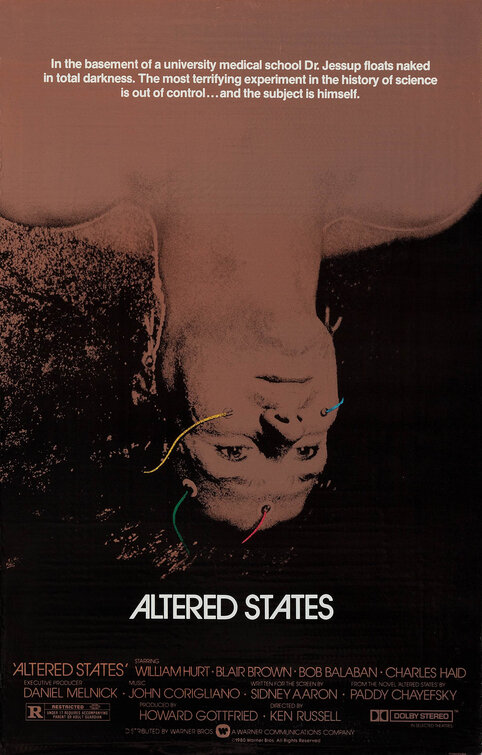
I've been intrigued by sensory deprivation since watching the 1980 movie Altered States, but now I'm wildly curious. Word online is that float tanks are common features at spas these days, and though I've yet to come across one, I'm going to start asking around. Who knows what else I might wind up writing?
9/10/2008
Lost won; Fringe is frayed: a study of character vs. plot
Okay, lame title for a comparison of JJ Abrams series.
For the past several weeks I've been embroiled in an on-and-off argument with a friend of mine. It relates to how we define quality writing and how we use the terms "literary" and "genre," among other things. (I use "literary" in a positive way and until recently had been using "genre" derogatorily; she extols the virtues of "genre" and uses "literary" derogatorily, though she also considers "literary" as a kind of genre itself. This latter point I cannot disagree with and I've come to shift terms, describing the schlock I once called "genre" as "Wal-Mart fiction" or "airport novels.")
One of the issues we've hit on in our debate is the importance of plot versus the importance of character. And last night, I stumbled across an interesting comparison of the two approaches: I watched the pilot episode of Fringe, the new JJ Abrams series on Fox, and found myself comparing it to Abrams's creation Lost on ABC. Fringe, I would argue, is a plot-driven series (or, at least, the pilot was, and from what I saw of the series teaser and from what I've read in reviews, the rest of the series follows that formula). Lost, my friend and I have often agreed, is character-driven.
For the past several weeks I've been embroiled in an on-and-off argument with a friend of mine. It relates to how we define quality writing and how we use the terms "literary" and "genre," among other things. (I use "literary" in a positive way and until recently had been using "genre" derogatorily; she extols the virtues of "genre" and uses "literary" derogatorily, though she also considers "literary" as a kind of genre itself. This latter point I cannot disagree with and I've come to shift terms, describing the schlock I once called "genre" as "Wal-Mart fiction" or "airport novels.")
One of the issues we've hit on in our debate is the importance of plot versus the importance of character. And last night, I stumbled across an interesting comparison of the two approaches: I watched the pilot episode of Fringe, the new JJ Abrams series on Fox, and found myself comparing it to Abrams's creation Lost on ABC. Fringe, I would argue, is a plot-driven series (or, at least, the pilot was, and from what I saw of the series teaser and from what I've read in reviews, the rest of the series follows that formula). Lost, my friend and I have often agreed, is character-driven.
But, to return for a moment to the argument of craft and writing: My friend (who is finishing a PhD in creative writing from the same program I earned my degree from) has observed that most writing teachers avoid teaching or even refuse to teach plot. She contends that some people choose not to teach plot because they fail to understand plot beyond its basic elements. But I have to wonder if no one teaches more than the basics of plot because there is no more beyond the basics. Plot, in my experience, is a basic element, quickly understood and mimicked. I suppose one might look for ways to go about constructing complexity in plots, strategies for creating intricate patterns of action (I do--it's an area I continue to work on, usually without much success), but then we'd be teaching formula, which is a very different sort of writing, and it can be found more easily and more appropriately in books on the subject than it could in a classroom.
I was glad to stumble across a similar idea in the comments of Robin McKinley, a sometimes-YA author whom many would probably label a "genre" writer, though I want to argue she manages to transcend the trappings of genre and write with a literary attention to art. I've only read the one book so far, her fascinating vampire/sci-fi novel Sunshine, but the writing was good enough that I plan to read more. I also looked her up to see what she has to say about the craft, and I discovered a handful of comments in her FAQs online.
McKinley professes to be an inspiration writer, claiming her stories "come to her" or "happen to her" as though through a muse; she barely claims ownership of her own work. But that doesn't prevent her from being aware of her process and the influence she has over the stories that happen to her. She does acknowledge what my friend is seeking--the need for instruction in how to construct plots: "One of the trickiest bits about writing a story is getting the connections to look inevitable," she writes in one section of her FAQ. "When I've managed to put a scene in the wrong place, it's not merely a question of putting it in the right place; I have to rewrite all the connections too — including checking all other scenes in the vicinity to make sure there aren't references to the newly-moved scene in its old location." But she claims to have learned how to accomplish this from exactly the sources I'd have expected: not in a classroom but in books.
Alternatively, you can drop a character in an empty white room and take away all the doors and windows, and you can still have a compelling and fascinating story. There is no plot at all--nothing to accomplish, no physical action--but there's plenty of character, and I say that's where fiction begins and ends. I'm oversimplifying, I know--to simply drop in a character and describe their situation and environment is, at best, a sketch, so if the fiction is to be successful, the plot will develop from the character, and our lonely soul in the white room will slowly go mad trying to escape or else become enlightened in the acceptance of their fate, and this would be the plot. (The film Johnny Got His Gun--source text for Metallica's epic "One"--deals with an even better scenario, in which a man is hit by a mortar shell and winds up with both arms and both legs amputated, blinded by the flash and deafened by the roar of impact, and his spine severed in such a way that he's lost all sense of touch or taste or smell. He is literally left as only a mind, alone in the dark, deprived of everything--including "plot." And yet, from this, we receive narrative.) But my point is, if we write a plot and then try to place characters into it, we have a terribly difficult time making those characters believable or interesting, whereas if we write a character and then see what happens to them, the sky's the limit plotwise and we might also stumble upon art. This, I would argue, is the mode of probably 85%, maybe 90% of all contemporary literary art.
Anne Lamott agrees, I'm happy to say. In her book Bird by Bird--a simple text on writing, famous for its often-anthologized chapter "Shitty First Drafts"--she writes a chapter on "Plot":
My friend and I are both Lost fans. (I would say "fanatics," but I've read some of the Lostpedia, and I know how obsessive the real fanatics can be, so I won't diminish their devotion to the show by claiming to be one of them.) We both love the show for similar reasons, and when we both first began geeking out over Lost, we mentioned how terrifically character-driven the show is. I've read interviews with Abrams and the other creators expressing exactly this intent: that the show was intended as a study of characters, both of individual characters and of their interactions with each other. Whatever plot developed (and until recently the writers freely admitted that there was no plot--they were just making things up as they went), the story was directly dependent on the nature of the characters. The pilot episode of Lost begins with a close-up on Jack's eye precisely to illustrate that whatever we're about to see is going to be through Jack's experience, from his perspective, focused (if you'll excuse the pun) on Jack's character. And, true to form, most of the first-season episodes begin in the same way--a close-up on a character's eyes to hint at that episode's focus on that character. The show dropped the visual device eventually, but with the exception of a few season-three missteps, it has never abandoned its focus on character. Yet it also boasts some of the most complex plotting in the history of television, and it does this not through any speculative sci-fi formulas but through following the natural developments and possible interactions (a Buddhist would say interdependence) of its characters.
Last night's pilot for Fringe, co-created by Abrams, lost all that magic and settled instead for the coincidences, conveniences, and forced developments of a plot-driven narrative. Like Lost, it begins with a plane crash, and like Lost, it relies on some vast underlying conspiracy and strange, inexplicable events to set up the situations in which the characters exist. But the characters are never characters. They're "Sort of Smart but Really Just Lucky FBI Agent," "FBI Agent's Lover Who Is Also An Agent," "Creepy Boss Who Seems At First to Be A Jerk But Who Really Has a Secret Agenda," "Mad Scientist" (I'm not making this up--it gets that cliche), "Mad Scientist's Brilliant But Edgy Son," and, of course, "The Villain." We're never expected to question these characters or really even care about them--we begin the story with "an incident" on a plane (all shock and horror, but not much substance), which thrusts our agents into the plot without more than a 30-second introduction, and the "action" (if you can call it that) railroads us through the rest of the episode. There is no concern on the part of the writers for who these people are, why they do what they do, what the implications are for them. They are tools in the story.
This is why Fringe failed for me as a show, and it serves as an interesting example of my problem with formulaic, plot-driven narrative as opposed to the introspective, character-driven narrative exemplified by Lost. Even though they're from the same creator.
McKinley professes to be an inspiration writer, claiming her stories "come to her" or "happen to her" as though through a muse; she barely claims ownership of her own work. But that doesn't prevent her from being aware of her process and the influence she has over the stories that happen to her. She does acknowledge what my friend is seeking--the need for instruction in how to construct plots: "One of the trickiest bits about writing a story is getting the connections to look inevitable," she writes in one section of her FAQ. "When I've managed to put a scene in the wrong place, it's not merely a question of putting it in the right place; I have to rewrite all the connections too — including checking all other scenes in the vicinity to make sure there aren't references to the newly-moved scene in its old location." But she claims to have learned how to accomplish this from exactly the sources I'd have expected: not in a classroom but in books.
You can also learn a lot by sheer plagiarism, so long as you recognise that that is what it is and that it's only a writing exercise. I wrote an awful lot of very bad Tolkien pastiche when I was younger — I didn't realise what I was doing at first, but even when I began to, later on, I could see that I was learning a lot about characterisation and plot development, how you get people from one place to another, how much background you need, how to slip in information your story is going to need later, how to lay a good ambush for the innocent reader — and so I kept on with it, when I couldn't think of any stories of my own.I love McKinley's comments because (and I suspect this is true for most writers) they sound familiar to me. I was writing great plots when I was 14 years old. Really fascinating, action-packed narratives, stories about drug dealers and alien races and genetic experiments gone wrong. But they were cartoony, with broad outlines and only four colors. I needed the attention to detail and the nuances of a nearly psychological focus on character to make my fiction live, to make it real. I'll grant you, I'd have liked more concrete suggestions on how to go back and recombine those things, but then, I don't believe it's always necessary. John Irving does--he says fiction begins and ends with plot, and to hell with anyone who says otherwise. But I disagree. I can pick up a textbook on natural science and read about the formation of the planet, and it'll be rife with plot--the world is full of conflict and action and resolution and even narrative arcs, and we don't need people to create those. But it's not story--it's science.
Alternatively, you can drop a character in an empty white room and take away all the doors and windows, and you can still have a compelling and fascinating story. There is no plot at all--nothing to accomplish, no physical action--but there's plenty of character, and I say that's where fiction begins and ends. I'm oversimplifying, I know--to simply drop in a character and describe their situation and environment is, at best, a sketch, so if the fiction is to be successful, the plot will develop from the character, and our lonely soul in the white room will slowly go mad trying to escape or else become enlightened in the acceptance of their fate, and this would be the plot. (The film Johnny Got His Gun--source text for Metallica's epic "One"--deals with an even better scenario, in which a man is hit by a mortar shell and winds up with both arms and both legs amputated, blinded by the flash and deafened by the roar of impact, and his spine severed in such a way that he's lost all sense of touch or taste or smell. He is literally left as only a mind, alone in the dark, deprived of everything--including "plot." And yet, from this, we receive narrative.) But my point is, if we write a plot and then try to place characters into it, we have a terribly difficult time making those characters believable or interesting, whereas if we write a character and then see what happens to them, the sky's the limit plotwise and we might also stumble upon art. This, I would argue, is the mode of probably 85%, maybe 90% of all contemporary literary art.
Anne Lamott agrees, I'm happy to say. In her book Bird by Bird--a simple text on writing, famous for its often-anthologized chapter "Shitty First Drafts"--she writes a chapter on "Plot":
Plot grows out of character. If you focus on who the people in your story are, if you sit and write about two people you know and are getting to know better day by day, something is bound to happen.Which brings me back to JJ Abrams.
Characters should not, conversely, serve as pawns for some plot you've dreamed up. Any plot you impose on your characters will be onomatopoetic: PLOT. I say don't worry about plot. Worry about the characters.
My friend and I are both Lost fans. (I would say "fanatics," but I've read some of the Lostpedia, and I know how obsessive the real fanatics can be, so I won't diminish their devotion to the show by claiming to be one of them.) We both love the show for similar reasons, and when we both first began geeking out over Lost, we mentioned how terrifically character-driven the show is. I've read interviews with Abrams and the other creators expressing exactly this intent: that the show was intended as a study of characters, both of individual characters and of their interactions with each other. Whatever plot developed (and until recently the writers freely admitted that there was no plot--they were just making things up as they went), the story was directly dependent on the nature of the characters. The pilot episode of Lost begins with a close-up on Jack's eye precisely to illustrate that whatever we're about to see is going to be through Jack's experience, from his perspective, focused (if you'll excuse the pun) on Jack's character. And, true to form, most of the first-season episodes begin in the same way--a close-up on a character's eyes to hint at that episode's focus on that character. The show dropped the visual device eventually, but with the exception of a few season-three missteps, it has never abandoned its focus on character. Yet it also boasts some of the most complex plotting in the history of television, and it does this not through any speculative sci-fi formulas but through following the natural developments and possible interactions (a Buddhist would say interdependence) of its characters.
Last night's pilot for Fringe, co-created by Abrams, lost all that magic and settled instead for the coincidences, conveniences, and forced developments of a plot-driven narrative. Like Lost, it begins with a plane crash, and like Lost, it relies on some vast underlying conspiracy and strange, inexplicable events to set up the situations in which the characters exist. But the characters are never characters. They're "Sort of Smart but Really Just Lucky FBI Agent," "FBI Agent's Lover Who Is Also An Agent," "Creepy Boss Who Seems At First to Be A Jerk But Who Really Has a Secret Agenda," "Mad Scientist" (I'm not making this up--it gets that cliche), "Mad Scientist's Brilliant But Edgy Son," and, of course, "The Villain." We're never expected to question these characters or really even care about them--we begin the story with "an incident" on a plane (all shock and horror, but not much substance), which thrusts our agents into the plot without more than a 30-second introduction, and the "action" (if you can call it that) railroads us through the rest of the episode. There is no concern on the part of the writers for who these people are, why they do what they do, what the implications are for them. They are tools in the story.
This is why Fringe failed for me as a show, and it serves as an interesting example of my problem with formulaic, plot-driven narrative as opposed to the introspective, character-driven narrative exemplified by Lost. Even though they're from the same creator.
1/26/2008
Spider-Man becomes Single-Man?
This semester, as we study pop culture and critical interaction with a "text" (really, any medium), I'm making my students write a series of short, informal response essays. And I figured, what's good for the goose.... So, this is the "sample response" I've written for them, in all its shabby inglory:
Last fall, I read an article in The Journal of Popular Culture titled "'With Great Power Comes Great Responsibility': Cold War Culture and the Birth of Marvel Comics." The latter half of the title is misleading; the article is less about the Cold War and more about the ways in which Stan Lee single-handedly revolutionized the comic book industry and forever changed our idea of the superhero. Not to get too into the article itself, my own favorite section of it dealt with Peter Parker and the invention of the teenage hero.
I wasn't as obsessive as the stereotypical "comic-book geek" (I was certainly no Comic Book Guy from The Simpsons), but I read my share of comics in high school and college (I hung out with Comic Book Guy from The Simpsons), and I still have my collection. Spidey was always a favorite of mine, for most of the same reasons this article points to: He was my age--a teenager/young adult--but he was a hero in an adult world and could handle adult villains easily; he was a geek in the world but secretly cool, shy and unsure around his love-interests but hip and sarcastically eloquent as his alter-ego; and, though he was super-strong and super-agile, he often relied on his wits and intelligence to defeat his enemies. Better still, he was troubled: He burdened himself with worries and responsibilities beyond the capacity of normal people and even beyond his own capacity sometimes. (We've long acknowledged a mental condition of involved self-sacrifice, wherein a person believes he or she is personally responsible for the salvation of the entire world; Buddhists call it bodhicitta, the compassionate desire to help all sentient beings; psychologists have long called it a "messiah complex"; but I wonder if we ought to start discussing, for my generation on down, the "Spider-Man Syndrome.")
Anyway, I started thinking about this article a week or so ago when I heard, much to my shock, that Peter Parker and Mary Jane Watson-Parker are splitting up. I caught the announcement on a brief news item on WPR, and for me, it was as earth-shaking as the death and resurrection of Superman, as surprising and intriguing as the assassination of Captain America. And I can't help wondering, now that Spidey (who is technically in his 40s but who ages slowly) and I are both older, leaving our youth and eying a not-so-distant middle-age, what the ramifications are going to be of Spidey's new "mid-life crisis."
I remember following the love affair of Peter and Mary Jane with the same zeal and personal investment with which my grandmother watched her soap operas. Mary Jane was my generation's ideal woman, for the comic book set anyway. She is smart, self-assured, outrageously sexy, just flirtatious enough.... We all wanted to marry Mary Jane. When I watch the second Spider-Man film (in my mind, the last, because film 3 was a rotten mess), I actually erupt in grinning tears—even now, after multiple viewings—every time Kirsten Dunst looks proud and glassy-eyed at Tobey McGuire and says her character's iconic love-phrase: "Go get `em, Tiger."
Strictly speaking, Peter and Mary Jane aren't breaking up or getting divorced. In a classic bout of comic-book silliness, they've lost their memories. Apparently, Peter's Aunt May was dying, and to save her life, Peter and Mary Jane jointly made a deal with the devil (okay, the comic-book character Mephisto, but it's the same thing), agreeing to erase their entire relationship. They haven't fallen out of love; they've just forgotten the last twenty-one years. So, Spider-Man is now a swinger in a multitude of ways, free now to engage in more dangerous, more exhilarating adventures, to take on greater responsibilities (though, really, what responsibility is greater than marriage?). And we readers, straight men and gay women alike, ought to be rejoicing: Mary Jane is available once more. But to be honest, I don't want her available. I prefer them both in love. As my heroic surrogate in super-literature, Peter Parker needs to stay with my ink-colored red-headed icon of sex and romance. Otherwise, I'm left with just another celebrity marriage gone awry, just another undoing of my carefully deluded adolescence.
Subscribe to:
Posts (Atom)
